Liliana Basarab - Art Making the Invisible
We talked to Liliana Basarab because her work sits at the intersection of memory, material, and feminism, using ceramics, textiles, and drawing to explore vulnerability as both a poetic and political space. With a practice rooted in conceptual art and a deep commitment to gender discourse, Liliana offers a compelling lens on how fragile forms can hold resilient histories. In her Bucharest studio, we explored how art can become both archive and act of resistance.
1.WHAT WOULD MAKE YOUR SOUL SING? WHAT MAKES YOU HAPPY?
That fleeting moments when everything just click, there are some pauses in the chaos, and for a moment, the world makes sense. It never lasts, but it’s enough to keep going. That feeling makes my soul sing.
Also, Prosecco. Always Prosecco.
2. A CHILDHOOD STORY THAT ANNOUNCED THE CREATIVE PERSON YOU ARE TODAY
If there's something from my childhood that stayed with me, it's not necessarily the drawing or anything obviously artistic. It’s more about the thrill of discovery, the curiosity. I remember being absolutely convinced I could invent a sixth taste. I spent a lot of time mixing sugar and salt in different proportions, sure I was on the verge of a revolutionary discovery — something the world had somehow missed. And I truly believed I was the first to think of it. Or the times I tried to make perfume by soaking flower petals in alcohol. It never worked. Not once. But that didn’t matter. It was about the excitement of having an idea and just diving into it. No fear of failure, no overthinking. Just the joy of trying, of chasing something unknown. I think that feeling stayed with me. Even now, I don’t always know if something will work — and honestly, that’s not the point. It’s the thrill.
As a kid, I used to read and daydream — a lot. One of my vivid memories is the first time I finished a long story. It was in a book called Zâna Zânelor, and the story was 30 pages long, which felt huge back then. I remember so clearly the feeling I had when I finished it — it was magic. Like I had just won a small battle. I think I’ve just kept moving in that direction. I look for those little wins — the quiet, personal ones that feel meaningful only to me. And I think those small victories, stacked one on top of the other, are what make up my days, my months, my years. Just little wins, quietly adding up to something.
3. BEST CONTEXT EVER FOR INSPIRATION WAS
The best context for inspiration, for me, is when I’m really connected to myself — when I allow things to come to the surface without immediately judging or censoring them. It’s that space where I feel safe enough to be vulnerable, to sit with uncomfortable thoughts or emotions without trying to fix or hide them. Inspiration often doesn’t come from exterior. It comes quietly, when you slow down enough to listen. As an artist, I spend a lot of time in my head. So for me, the best context isn’t a place, really. It’s a state of being. But well, could be on lovely place, maybe a terrace, or a rooftop, with a nice glass of Prosecco.

4. THE PROJECT YOU LOVED MOST
The project I loved most — the one that really felt like me — was something I was part of for five years. It was a team effort, but also a personal space. I was one of the co-organizers of the Sofia Nădejde Festival of Literature Written by Women, and it was more than just a project. It was a mix of activism, community, and creativity — and I happy to be part of it. I was involved in the decisions, but also had my own role. I worked on the visual identity, designed the trophies, and shaped how the project looked. I am proud to have been part of it. What I loved most was that it gave me a space where I could be an artist — not just doing a bit of graphic design on the side, but my practice as an artist was woven into the project. I also really valued the people I worked with — the energy, the shared drive, the feeling that we were creating something important together. Even all the insecurities we had. It was exactly that kind of space I always look for: a niche within a community. A space for contradiction, difference, and acceptance — but one that doesn’t silence anyone’s voice. And I’m happy the project didn’t just end. It continued in other forms, like Retroversiuni Anthology of Literature Written by Women — smaller, different, but still based on the same values of celebrating women’s voices.
5. THE PROJECT OTHERS LOVED MOST
I have no idea what is the project other people loved most.

6. THE BEST THING ABOUT ROMANIAN CREATIVITY IS
The best thing about Romanian creativity is how it thrives in constraint. Give a Romanian artist a broken chair and a bit of wire, and they’ll make something unforgettable. It’s inventive, adaptive, and full of unexpected poetry.
7. BEST STATEMENT OF ROMANIAN HUMOR
Romanian humor can be crass, strong, sometimes a bit inappropriate — and often hard to translate. I like it mostly because it feels like you could cry, but you choose to laugh instead. A bittersweet space between sadness and absurdity. A mix of self-deprecation and vulnerability. You’re not just making fun of others — you’re also putting yourself in the same spot. You’re laughing with, not at. You joke instead of crying. You laugh as a way to deal with the world. And I think that’s why it’s so hard to translate. Humor doesn’t always carry over easily across languages. But I love those moments when you’re with people from the same place or generation, and you don’t even need to tell the whole story — just the punch line. And everyone gets it. It’s that instant recognition of a shared background. I find that kind of connection through humor is powerful.

8. ADVICE FOR INTERNATIONAL HEADHUNTERS, RELATED TO ROMANIAN CREATIVES
Hmm. If I had to give some advice to international headhunters about Romanian creatives, I’d say: expect stubbornness — in the best way. We’re driven, we stick with things, and we care about what we do. Also a strong mix of skills. Many creatives combine craftsmanship with conceptual thinking. It’s not just about making beautiful things, but making things with meaning. It’s rarely empty or superficial.
9. BEST PLACE IN BUCHAREST
Of course, Atelierele Malmaison. Just come visit during Open Doors events — that’s when you really feel the energy of the place. I also go often to Manasia Hub — another space that, in its own way, shares a similar vibe. It’s multicultural, open, and definitely progressive. Both places make room for community, conversation, and creativity. And that’s what I’m always looking for.
10. BEST PLACE IN YOUR COUNTRY
Bucharest, chaotic but full of charm
11. MOST DISTURBING CLICHÉ ABOUT ROMANIA, IN THE MEDIA OUTLETS OF THE WORLD IS
The vampires, I know not very disturbing but for sure very boring, I already know all the combination of jokes.

12. ROMANIA SHOULD BE KNOWN FOR
Diversity
13. YOUR VIEWS ON SPIRITUALITY
It’s a tricky question — a bit hard to answer, to be honest. When it comes to spirituality, I think I’m more connected to the little things I’ve picked up from my mother and grandmother — old superstitions, small rituals, gestures that make sense even if they’re not part of a big belief system. For me, religion or spirituality is more like a way of making sense of the world, of putting some kind of order into chaos. It’s a framework. A way to find meaning, even if it's imperfect. I sometimes struggle to relate to people who are really into horoscopes and zodiac signs. I understand the need — it’s another lens to look at life through. But I don’t like when people use it to label others, like, “You’re a Virgo, so you must be like this.” It feels like a conversation-stopper. Like it shuts down curiosity about the actual person in front of you. So I’d say my version of spirituality is quiet, a bit instinctive, and tied to tradition — with a focus on doing no harm, trying to do your best, and trying to see the good in others. Nothing dramatic. Just a way of staying grounded.
14. YOUR VIEWS ON MONEY
Artists often have a complicated relationship with money. In general, we don’t really know how to talk about it — especially when it comes to our own work. The moment money enters the
conversation, things get blurry. It’s not just about pricing a piece. It’s about how money relates to the value of the work, to the process, to the outcome, to the context. It’s hard to separate emotions from it, because the work is so personal. And yet, we have to. We should learn how to value our work in a more grounded, more objective way — without feeling guilty or dramatic about it. We need to remind ourselves: it’s okay to ask for money. It’s okay to earn money from what we do. It’s okay to say no to unpaid projects. At the same time, if there’s a project you want to do, even if it’s unpaid — because it gives you joy, meaning, or growth — that’s also valid. But it has to be your decision, not a default. We need to think long-term, short-term, and everything in between.
15. AN INSPIRATION SOURCE YOU RECOMMEND FOR A YOUNG CREATIVE
I always recommend stepping outside your own bubble. If you’re a visual artist, go see theatre. If you’re into theatre, go to exhibitions. If you’re into literature, go see both. Just… go where you’re not expected to go.
I believe in communities — in breaslă, people who do the same kind of work and support each other. That’s important. But it’s also essential to push yourself to look from other perspectives. Inspiration doesn’t have to come from your field. Sometimes, it really shouldn’t. A good idea might come from something you barely noticed — a small moment, an unrelated event, something you weren’t even paying full attention to. And that’s okay. Some ideas you think a lot about might lead nowhere. Others, spontaneous ones, might turn into something great. In the end, what matters is showing up, staying open, and being willing to cross that line — from thinking into doing.
BIO
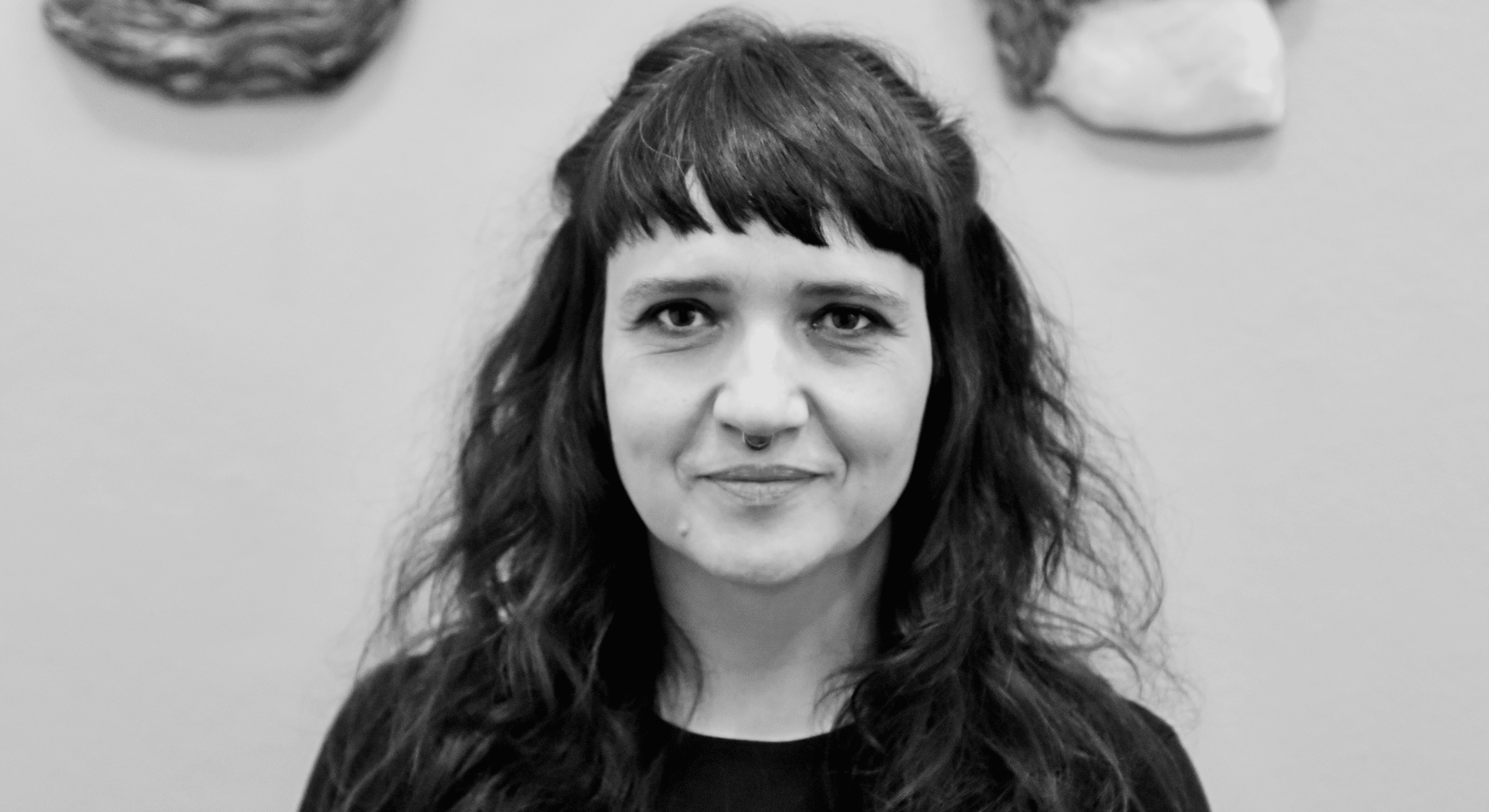
Liliana Basarab is a visual artist based in Bucharest, though she began her career in Iași in the early 2000s as part of the Vector Association, which organized the Periferic Biennial. She is interested in gender-related issues, and her conceptually driven practice spans various media such as ceramics, textile objects, drawing, and video. She collaborates with writer Elena Vlădăreanu on various projects and was part of the collective that organizes the “Sofia Nădejde Awards for Literature Written by Women.”